
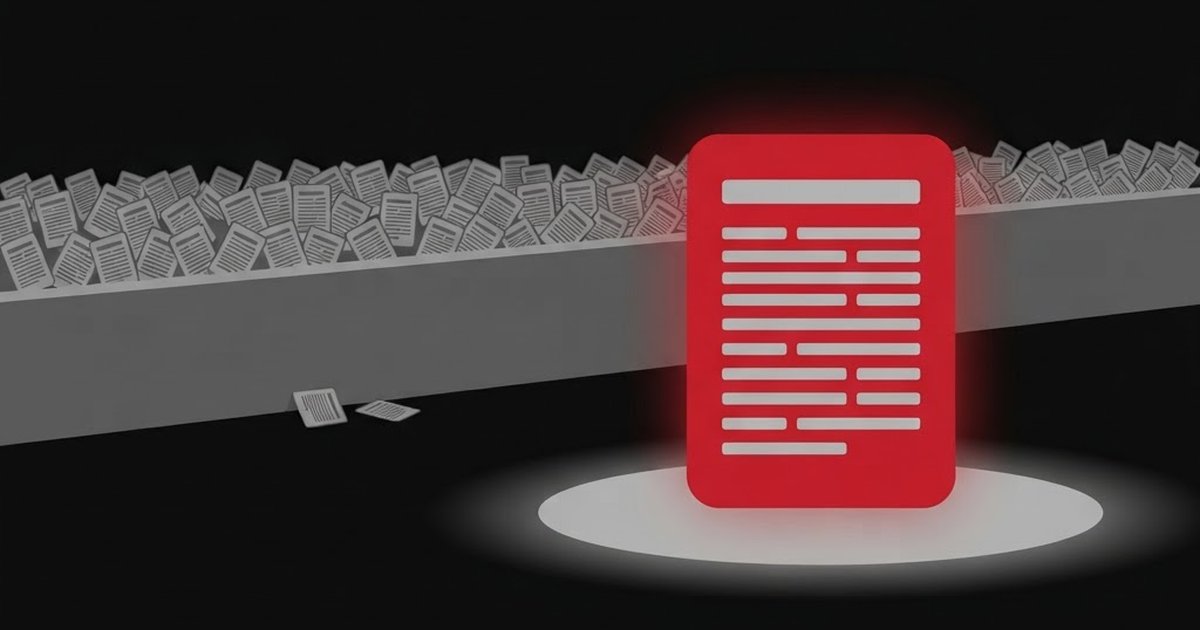
LinkedIn Says It Catches AI Slop With 94% Precision. Here Is What That Means for Your Posts.
Using AI to help write a LinkedIn post is still fine. On October 8, 2026, LinkedIn's Tim Jurka said its AI-slop detection now covers every post sent beyond your immediate network (LinkedIn, October 8, 2026). He said it is right 94% of the time when it flags one. Nothing gets deleted. Generic posts just stop reaching anyone new.
What LinkedIn Said on October 8, 2026
Jurka published a post explaining how LinkedIn finds AI slop. Social Media Today, which covered it the same day, identifies him as LinkedIn's VP of Engineering (Social Media Today, October 8, 2026). His own post carries no job title.
Here is the line that matters: "Leveraging both our student-teacher framework and our agentic workflows, we've recently expanded our classifiers to cover all posts that are distributed beyond your immediate network with 94% precision at detecting AI-slop" (LinkedIn, October 8, 2026).
A classifier is software that sorts things into buckets. Here there are two buckets, slop and not slop.
Two claims sit in that sentence. The first is coverage. As of October 8, 2026, the detection runs on every post LinkedIn shows outside your own network. The second is the 94%.
LinkedIn's own definition of the target, published September 15, 2026, is worth reading closely. "AI slop" includes "low-effort, likely AI-generated content that may sound polished on the surface but lacks a clear point of view, unique perspective, or substance" (LinkedIn News, September 15, 2026). Nothing in there is about whether a machine helped you type.
One note on sourcing. As of October 13, 2026, we found this claim in three places: Jurka's own post, Social Media Today, and two industry newsletters. We did not find it in the larger tech press. It is a company statement, not an audited result.
What 94% Precision Actually Means
Precision has a specific meaning, and it is narrower than it sounds.
Google's machine learning course defines it plainly: "Precision is the proportion of all the model's positive classifications that are actually positive" (Google, last updated January 12, 2026). In this case, of the posts LinkedIn flagged as slop, 94% really were slop.
So the 94% tells you nothing about how much slop sails through. It also tells you nothing about how often a real person, writing real sentences, gets caught by mistake.
That last number is the one that should interest you, and LinkedIn has not published it. "LinkedIn's 94 per cent accuracy claim sounds impressive, but the company has not shared data on false positives," The Next Web wrote on May 20, 2026 (The Next Web, May 20, 2026). As of October 13, 2026, we could not find a false-positive rate, a recall figure, or any outside audit of the 94%.
One more wrinkle. There are two different 94% figures from 2026. On May 20, 2026, LinkedIn said, "In our initial testing, we're correctly identifying generic content 94% of the time" (LinkedIn, May 20, 2026). That was test accuracy. The October 8, 2026 figure is precision in live use. Same digits, five months apart, two different claims.
What Happens to a Post That Gets Caught
It does not come down.
LinkedIn's help page puts it in one line: "Content that feels generic, repetitive, or lacks a clear point of view is less likely to be widely distributed" (LinkedIn Help, checked October 13, 2026). In May 2026 the company was more specific. Content that looks AI-generated and lacks a clear perspective is "less likely to be widely distributed" beyond a person's immediate network (LinkedIn, May 20, 2026).
Entrepreneur described the same mechanism after interviewing LinkedIn in May 2026. "LinkedIn won't delete posts it believes are AI slop," it reported, and the algorithm will "depress that content's reach", often keeping it from being seen beyond the poster's first-degree contacts (Entrepreneur, May 19, 2026). First-degree contacts are the people you are directly connected to.
So the post stays on your profile. People who already follow you still see it. Strangers stop seeing it. For most businesses, strangers are the entire point of posting.
If it happens, you may get a quiet heads up. "If a post gets enough community feedback from other members, you'll see a tip in your Post analytics" (LinkedIn Help, checked October 13, 2026). LinkedIn adds that the tip does not mean your post came down, or that any policy decision was made. Your audience never sees it.
It Is Feedback, Not a Report
One correction here, including to something we wrote ourselves.
When this started, the press called it a report button, and so did we in our first post on August 21, 2026. LinkedIn's help page now says something narrower. You click the More icon on a post, then "Seems like AI slop", and that feedback "does not indicate a policy violation or trigger a reporting flow" (LinkedIn Help, checked October 13, 2026). As of October 13, 2026, it covers posts and comments in your feed.
LinkedIn is not consistent about this itself. Its September 15, 2026 press release describes members as "reporting content as 'seems like AI slop'" (LinkedIn News, September 15, 2026).
The practical difference matters. Someone clicking that option does not put a mark on your record. It feeds the system that decides how far your next post travels.
The timeline, since this moves fast. On July 30, 2026, TechCrunch reported the new button, and LinkedIn swapping its own "enhance your post" writing tool for one that "proofreads your words, instead of changing your voice" (TechCrunch, July 30, 2026). Hari Srinivasan, LinkedIn's chief product officer, said then: "AI slop is a top priority for all of us" (TechCrunch, July 30, 2026).
It got used. LinkedIn said on September 15, 2026 that "More than 1 million members have used the new 'Seems Like AI Slop' button since we rolled it out in August" (LinkedIn News, September 15, 2026). On August 21, 2026, Srinivasan wrote that members "are now experiencing 40% less views on what we classify as AI slop from just a few weeks ago" (Engadget, August 21, 2026).
What LinkedIn still has not said, as of October 13, 2026, is how much feedback it takes before anything happens to a post. Engadget called the company "cagey" about exactly that on August 21, 2026 (Engadget, August 21, 2026).
How the Detection Works Now
Jurka described two moving parts on October 8, 2026.
The first is a teacher-student setup. Large "teacher" models are "designed to keep up with new AI-slop patterns", and what they learn becomes training material for the small, fast models that score posts at scale (LinkedIn, October 8, 2026). LinkedIn says it updates those smaller models with "techniques such as Low-Rank Adaption (LoRA)" rather than rebuilding them (LinkedIn, October 8, 2026). In plain English, the system can learn this month's pattern without starting over.
The second is a set of AI agents. An agent is software that takes steps on its own. "Each agent is guided by a specific policy, which defines the criteria it uses to evaluate content," Jurka wrote, and when one hits a case it cannot work out, "it can surface that example to our human reviewers" (LinkedIn, October 8, 2026). All of this runs across what the same post calls "1.4 billion members" (LinkedIn, October 8, 2026).
Here is the part that affects you. The system is built to keep changing. Whatever slipped through in August 2026 is not guaranteed to slip through now.
Most Long LinkedIn Posts Are Already Machine-Written
Here is the backdrop. Pangram, which sells AI detection, scanned 1,002,627 posts shared by people who installed its browser extension, starting April 24, 2026. It reported that "LinkedIn was the most AI-saturated platform, where more than 40% of longform posts flagged as fully AI-generated" (Pangram, July 9, 2026). Longform there means over 250 words. Originality.ai, using a looser bar of 100 words and counting AI-assisted posts too, put the share above 80% in July 2026 (Originality.ai, July 30, 2026). Both sell detection, and as of October 13, 2026 we could find no peer-reviewed count, so read them as a direction, not a census.
Here Is Our Own Number
This blog is drafted by an agent pipeline and edited by a human. We promote it on LinkedIn, so our own habit is the test case.
Six LinkedIn posts drawn from this blog have gone up as of October 13, 2026. The first was August 26, 2026, the most recent October 12, 2026. Four more are written and waiting. Every one was drafted by the agent from the published article, then edited and posted by hand.
The edit is not a formality. The agent draft behind our post on an AI blogging survey took under four minutes on September 16, 2026. The human edit took about 30 minutes, on purpose (Ninth Degree, September 21, 2026).
Four minutes of drafting. Thirty minutes of a person deciding what is true and what is worth reading. That ratio is exactly what LinkedIn's definition is asking for, and no classifier will ever do it for you.
Here is what we cannot tell you, and nobody honest can. We do not know whether any of those six posts was ever flagged or quietly held back. LinkedIn does not report that to a poster, and our own dashboard has no field for it.
What to Do This Week
Read your last ten posts like a stranger. LinkedIn publishes its own checklist of what reads as slop, written for advertisers but useful for anyone. Content can feel like slop if it "Uses generic claims that could apply to any business", "Repeats ideas without adding useful information", or "Lacks a clear brand perspective or point of view" (LinkedIn Marketing Solutions Help, checked October 13, 2026). Score your own posts against those three.
Put one thing in each post that only you could know. A number from your own books, what a customer said this week, what you got wrong last quarter. LinkedIn says AI-assisted content "is welcome when it reflects a real person's perspective, experience, or expertise" (LinkedIn Help, checked October 13, 2026). One owned detail is the cheapest way to pass that test.
Use AI as a proofreader, not a ghostwriter. LinkedIn made that swap in its own product in 2026, trading its post-writing tool for one that proofreads instead (TechCrunch, July 30, 2026). Take the hint about which half is yours.
Say that you used AI. One line is enough, and LinkedIn recommends it rather than requiring it (LinkedIn Help, checked October 13, 2026). Its position as of May 20, 2026: "It's ok to use AI to help you write, but your posts and comments need to represent your voice and your perspectives" (LinkedIn, May 20, 2026). Disclosure is not a confession.
Check Post analytics before you panic. That private tip is the only signal LinkedIn gives you (LinkedIn Help, checked October 13, 2026). Otherwise compare posts at the same age, about a week old, and watch whether the right people still comment. One quiet post proves nothing.
One Thing to Skip
Skip rewriting your posts to beat the detector. The teacher-student setup exists specifically to keep up with new patterns (LinkedIn, October 8, 2026). Anything you reverse-engineer this month becomes training data for the next one.
And skip the worry about using AI at all. By LinkedIn's own definition, the target is content with no point of view, not content with help behind it (LinkedIn News, September 15, 2026).
This post was drafted by Ninth Degree's agent pipeline and edited by a human before publishing. We have no view into how LinkedIn scored any post, including ours, so nothing here is a test of its classifier. Working out how to show up on a platform that keeps rewriting its rules is the call we make for clients every month.
Sources
- Tim Jurka on the technology behind LinkedIn's fight against AI slop, LinkedIn, October 8, 2026
- Report on the LinkedIn engineering post, Social Media Today, October 8, 2026
- LinkedIn's update on how it is tackling AI slop, LinkedIn News, September 15, 2026
- Best practices for content created with the help of AI, LinkedIn Help, checked October 13, 2026
- Share feedback on AI slop, LinkedIn Help, checked October 13, 2026
- AI slop feedback option for ads on the LinkedIn feed, LinkedIn Marketing Solutions Help, checked October 13, 2026
- Laura Lorenzetti on keeping conversations real on LinkedIn, LinkedIn, May 20, 2026
- Report on LinkedIn's button for AI-generated slop, TechCrunch, July 30, 2026
- Report on the AI slop button's early results, Engadget, August 21, 2026
- Report on LinkedIn's crackdown on generic content, The Next Web, May 20, 2026
- Report on LinkedIn fighting AI slop and AI comments, Entrepreneur, May 19, 2026
- Study of AI content across social feeds, Pangram, July 9, 2026
- LinkedIn AI content study, Originality.ai, July 30, 2026
- Classification: accuracy, recall, precision and related metrics, Google Machine Learning Crash Course, last updated January 12, 2026
- Almost everyone uses AI to write blog posts in 2026, Ninth Degree, September 21, 2026
- LinkedIn just started flagging AI slop, Ninth Degree, August 21, 2026